Blog Başlığı
Tarih
The biggest problem for a brand-new Instagram account is usually not content quality but vagueness. An account that posts a recipe one day, a holiday photo the next and a motivational quote after that confuses both viewers and Instagram's recommendation systems. People follow an account because they know what to expect from it.
The 10,000-follower goal in this course is a roadmap, not a promised result. But the first stop on that roadmap is the same for every account: getting clear on who you create for, what topic you cover and from which angle. That is exactly what this lesson is about.
Instagram's recommendation systems try to show a post to people who are likely to enjoy it. When your account consistently creates around one topic, the system can more easily "learn" which kinds of users to show you to. When the topic changes every day, each post starts almost from zero.
The second reason is human. When someone sees your Reel in Explore, they tap through to your profile and glance at your last 9-12 posts. If they see the same kind of value there, they think "the rest of this will be useful to me too" and follow. If what they see is scattered, they leave without following, no matter how good that single video was.
Choosing a niche does not mean talking about one topic for the rest of your life. In the 0-10K stage, focus is about establishing your account's identity. Once you have an audience, you can expand into adjacent topics in a controlled way.
Work through the steps below in order, on paper or in a notes app. Be honest at every step: a niche that looks great on paper but that you cannot sustain will be abandoned within a few weeks.
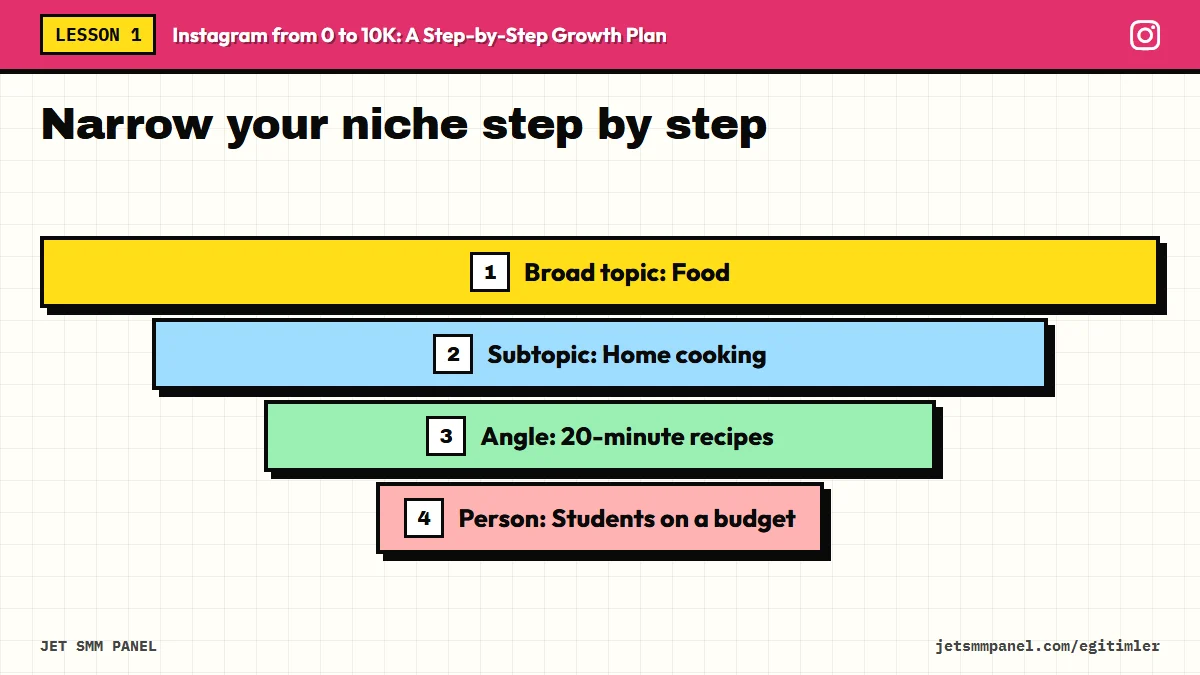
The table below shows how a broad topic can be narrowed down. The examples are purely hypothetical; the point is to show the way of thinking.
| Broad topic | Narrowed niche | Target person | Verdict |
|---|---|---|---|
| Fashion | Affordable office outfits | Women starting their first job | Clear |
| Fitness | No-equipment home workouts | Desk workers aged 30+ | Clear |
| Cafes | Laptop-friendly neighbourhood cafes | Remote workers and students | Clear |
| Hair care | Curly hair routines | People who want to stop straightening | Clear |
| Lifestyle | "A bit of everything" | Everyone | Vague |
| Tech | Product photos with a phone camera | Small shops and handmade sellers | Test it |
Narrowing too far is also a risk. A niche like "only vegan bakeries in one neighbourhood" can run out of ideas very quickly. Golden rule: your niche should be wide enough to produce at least 100 different content ideas.
Once you have chosen a niche, put it into a single sentence. This sentence is the filter every content idea has to pass through. When a new idea comes to mind, you ask, "Does this help the person in my statement?" If not, you don't post it.
My content is for [who]. I help them [solve which problem / reach which goal]. I do it [with which angle / what makes me different].
My content is for university students living in dorms or shared flats. I help them cook filling meals on a tight budget. I do it with one-pot recipes that never take more than 20 minutes.
After writing the statement, add some detail about that person. When during the day do they open Instagram? What words do they use? What do they struggle with most? Which accounts do they already follow? The answers will make it much easier to write hooks and carousel headlines later on.
There is one more decision to make: will the account be built around your personality, or will the topic itself take centre stage? Accounts that use their face and voice often earn trust faster, because people connect with people. But if you don't want to be on camera, that path is not closed: hands, screen recordings, product shots or voice-overs can all carry strong content. What matters is sticking with the style you choose consistently for at least a few months.
The most practical way to find out whether your niche is workable is to try writing 100 content ideas. They don't need to be perfect; headline-level notes are enough. If you get stuck at 40-50 ideas, your niche is probably too narrow or not the right fit for you. If you reach 100 comfortably, you have a solid pool for the months ahead.
Study 10 accounts in your niche, but don't copy them. For each, note the posts that got the most saves and comments, then ask, "From which angle could I explain this better or differently?" The difference between inspiration and imitation lies in adding your own angle.
Switch to a professional account (creator or business). It is free and you need it to access the insights screens we will use in Lesson 7. A personal account does not show this data.
Your profile showcase (photo, bio, highlights) is covered in a separate course; one rule is enough here: the first line of your bio should be a short version of your audience statement. Anyone landing on your profile should answer "Is this account for me?" within two seconds.
Don't switch niches every week because engagement is low in the early days. A new account's first posts reach few people; for most accounts that is a normal start. Don't decide until you have tested your niche with regular posting for at least 6-8 weeks.
Now that your niche and audience are clear, the next question is: which posts, in which formats, will you give this person each week? In the next lesson we will build your content pillars and the balance between Reels, carousels and Stories.
Today, write your audience statement using the template and start your 100-idea list. Don't move on until you have at least 30 ideas; in Lesson 2 we will sort that list into content pillars.