Blog Başlığı
Tarih
Short video journeys usually start the same way: posting every day in week one, every other day in week two, "it's been a busy week" in week three, and then a long silence. The cause is rarely a lack of ideas or talent. The cause is treating every video as a standalone project built from scratch. Hunting for an idea every day, setting up lights every day, opening the editor and adjusting settings every day spends your energy on preparation rather than on the video itself.
In this lesson we look at why a "7 videos a week" goal is only sustainable with a system, and we sketch the skeleton of the system we will build in the rest of the course: a week split into stages, a realistic time budget and a rhythm that fits your life.
A short video goes through six stages: idea, script, setup, filming, editing and publishing. When you run all six from start to finish every single day, three hidden costs appear.
Finding ideas is creative work, setting up lights is technical work, and editing takes patience and focus. Your brain needs a warm-up period every time it switches between these modes. With one video a day you go through those switches daily; with a weekly system you enter each mode once or twice a week, in long blocks.
Opening the tripod, positioning the light, clipping on the mic and tidying the background can take 15-30 minutes each time. Spending that time on one video versus seven videos makes a big efficiency difference. You set up once and use it seven times.
"What should I film today?" looks like a small question, but it gets heavy when you ask it every day. In a system, it is answered once a week during the planning session. On the other days you just execute.
| Stage | Daily improvising | Weekly system |
|---|---|---|
| Idea | Searched from scratch every morning Draining | Picked from the idea bank Fast |
| Script | Improvised while filming | Written in advance with a template Consistent |
| Setup | Rebuilt every day Time sink | Built once a week Efficient |
| Editing | Every project configured from zero | Ready-made project template Fast |
| Publishing | Whenever the video is done, at random times | Scheduled from the calendar Planned |
The system we build in this course has four parts. Each one gets a lesson or two; here is the big picture.
This course does not focus on hook-writing psychology or platform recommendation algorithms. The topic here is production operations: the process that turns good ideas into published videos on a regular basis. Content quality and production consistency complement each other; in the long run, one struggles without the other.
The heart of the system is one simple rule: the videos you produce this week are published next week. That way you always have a week of finished content in hand, a buffer. When you get sick, work piles up or filming day falls through, your account does not go silent.
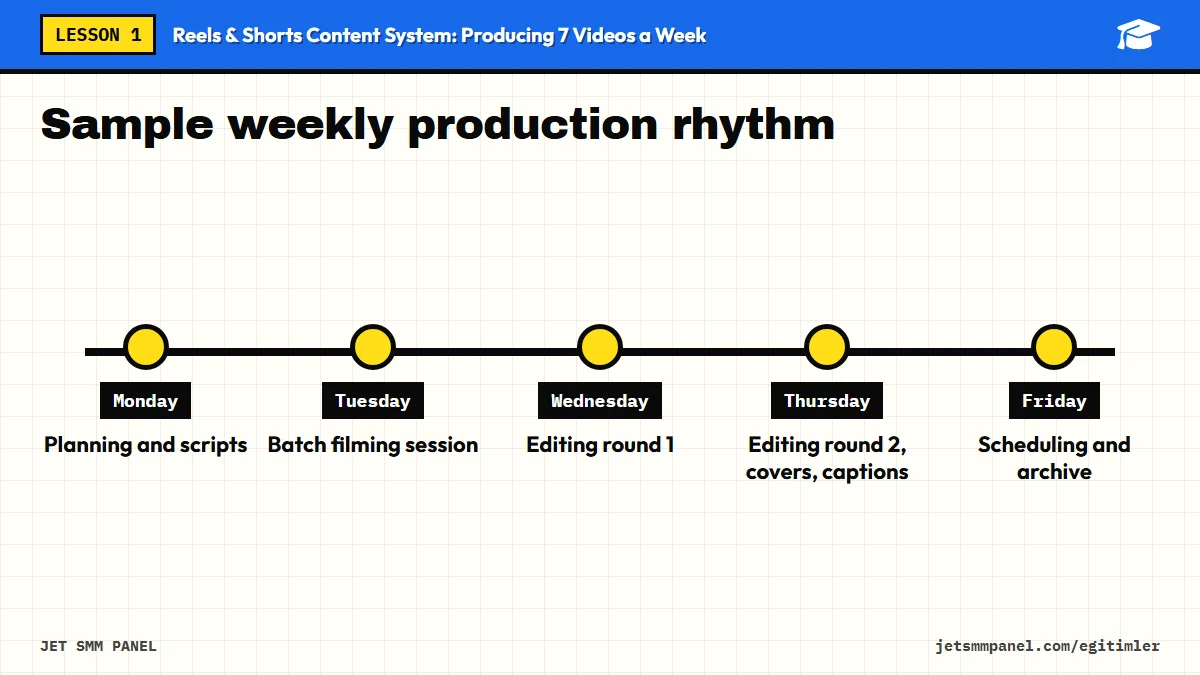
The table below is a sample layout for someone who works on weekdays. Shift the days to fit your schedule; what matters is the order of the stages and that each stage gets its own block.
| Day | Task | Estimated time |
|---|---|---|
| Monday | Planning ritual: pick ideas, write 7 scripts, shot list | 2 hours |
| Tuesday | Batch filming session | 3-4 hours |
| Wednesday | Editing round 1: rough cut, skeleton of all 7 videos | 2-3 hours |
| Thursday | Editing round 2: captions, music, covers, export | 2-3 hours |
| Friday | Descriptions, scheduling, archiving | 1 hour |
| Every day | Reply to comments, drop quick notes into the idea bank | 15-20 minutes |
In this example the weekly total comes to roughly 10-13 hours. It is normal for the first weeks to take longer; as your templates settle and your hands get faster, the time usually drops. These numbers are not a target, just a starting point for measuring your own time.
To build the buffer, make your first week a "production-only week". Produce, but post nothing. From week two onward you publish one week while producing the next, and you stay one step ahead.
Not everyone's life fits a single weekly filming day. Choose the model that suits you best from the three below; you can switch any time.
| Model | How it works | Who is it for? |
|---|---|---|
| Weekly | 1 filming day per week, 7 videos | People with a regular schedule Recommended |
| Biweekly | 1 long filming day every two weeks, 14 videos | People with rare access to a location or crew Intense |
| Hybrid | 5 planned videos per week + 2 spontaneous or trending ones | Niches that follow current events Flexible |
If even one video a week feels hard right now, do not jump straight to seven. Build the rhythm with 3 videos a week first; after two or three smooth weeks, move to 5, then to 7. Building the system matters more than raising the number.
Do not build the system under "every video must be perfect" pressure. With a 7-videos-a-week goal, some videos will be weaker than others; that is normal. Perfectionism breaks the rhythm, and once the rhythm breaks, even your best videos are less likely to get published.
This quick measurement becomes a reference point, so you can later check whether the system works for you. When you ask the same questions four weeks from now, you will see the difference in concrete terms.
The first building block is the idea bank, which permanently solves the "what should I film?" question. In the next lesson we will set it up step by step: where to collect ideas, how to tag them and how to decide which one to film first.
Answer the five checklist questions, pick the model that fits you and add planning, filming and editing blocks for next week to your calendar. Mark them like real appointments; even if you film nothing this week, have the days reserved.