Blog Başlığı
Tarih
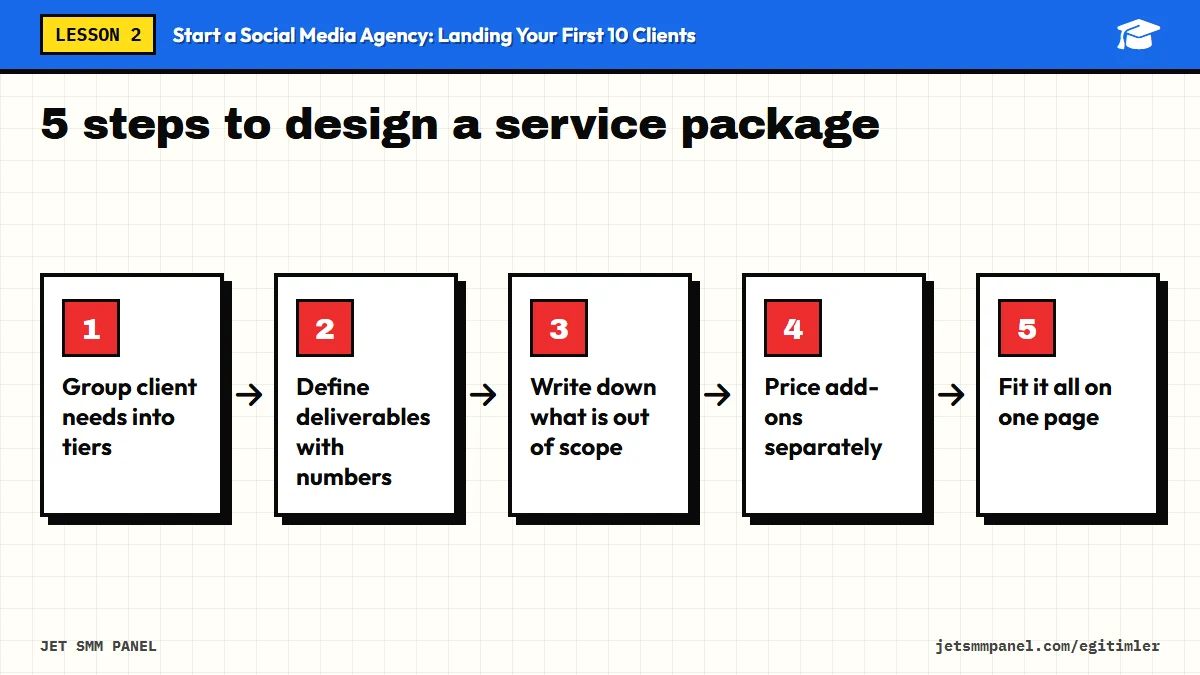
In your first conversation with a prospect, the question "How much?" always comes up. Answering it from scratch every time wears you out and does not inspire confidence. The fix is a set of service packages designed in advance, each with a clear scope. A good package lets the client understand at a glance what they will get, and lets you know your workload before you commit.
In this lesson we will build a three-tier package structure: starter, standard and premium. You will see how to set content volume, management scope and reporting level for each package and, most importantly, how to write down what is not included.
When you offer a single package, the client has only two options: yes or no. A three-tier structure invites comparison and moves the conversation from "Should we work together?" to "Which one fits me?" It also lets you open the door for a budget-conscious business with a starter package while offering a premium option to a business with bigger needs.
The core rule when designing packages: each package must differ from the previous one in a concrete, measurable way. Use numbers and deliverables instead of vague phrases like "more attention" or "priority service."
The table below is an example scenario. The numbers should change depending on your niche, your capacity and the client's needs. A cafe might need a package heavy on visuals and stories, while a consulting firm might need more educational posts.
| Item | Starter | Standard | Premium |
|---|---|---|---|
| Number of platforms | 1 platform | 2 platforms | 2-3 platforms |
| Monthly posts (image/carousel) | 8 | 12 | 16 |
| Short videos (Reels etc.) | 2 | 4 | 8 |
| Stories | 2 days a week | 4 days a week | Every weekday |
| Content plan | Monthly calendar | Monthly calendar + topic strategy | Monthly calendar + campaign plan |
| Community management | None / client handles | Comment replies during business hours | Comment + DM replies during business hours |
| Shoots | Client-supplied visuals | One half-day shoot per month | Two half-day shoots per month |
| Reporting | Short monthly summary | Monthly report | Monthly report + video call |
| Revisions | 1 round per piece | 2 rounds per piece | 2 rounds per piece |
The numbers in the table are a starting point, not an industry standard. Before you finalize a package, measure your own production times: how many hours does a carousel design, a short video edit or a monthly plan take you? Those times are the foundation of the pricing math in lesson three.
Phrases like "unlimited revisions," "24/7 replies" or "as much content as you want" look attractive in a pitch, but they quickly eat into your profit and your time. A service without limits cannot be priced correctly either.
Add-ons cover clients' flexible needs and keep your core packages simple. The list below is an example; pick the ones that suit your niche.
| Add-on | When it is requested | How to price it |
|---|---|---|
| Extra shoot day | New menu, new season, an event | Half day / full day |
| Extra short video | Campaign periods | Per piece |
| Account setup and cleanup | Newly opened businesses | One-off project |
| Competitor and industry analysis | Before a strategy change | One-off report |
| Team training | When the business wants to create some content in-house | Hourly or per session |
You can give your packages meaningful names, but the name should never overshadow the contents. "Starter / Standard / Premium" is simple and clear. If you use niche-specific names (for example "Launch," "Routine," "Growth"), always list what each one includes, with numbers, right under the name.
In organic social media work, it takes time for a content routine to settle, for you to see how the audience responds and to adjust the strategy. That is why many agencies set an initial period of a few months for monthly packages. State this term clearly on your package page and briefly explain why. Decide the length based on your own model and your clients' expectations; in lesson five you will see how to put it in the contract.
Standard Package - Monthly social media management for Instagram plus one additional platform.
Included: monthly content calendar and topic strategy, 12 posts a month, 4 short videos, stories 4 days a week, one half-day shoot per month, comment replies during weekday business hours, 2 revision rounds per piece, monthly report.
Not included: paid ads management, DM replies, weekend replies, website and logo work. These are priced separately as add-ons.
Your packages are ready, but they do not have prices yet. In the next lesson you will calculate your hourly cost, add your target profit and work out the price of each package step by step.
Build your three packages in a table based on your niche. Add a "Not included" list of at least four items under each package and prepare an add-on list with five items. Finally, estimate how long each deliverable type takes you (post, short video, story, monthly plan, report) and write it down; you will use these times for pricing in the next lesson.
Buy the course to unlock the remaining 6 lessons.