Blog Başlığı
Tarih
Most people who decide to start a social media agency begin with the same question: "Where will I find clients?" But two questions come before that one: what kind of business structure will you build, and who will you serve? These two decisions shape everything else, from your pricing and portfolio to your outreach messages and your workflow.
In this lesson you will compare the business models a small agency can choose from, then see why focusing on a niche (a specific industry or client type) makes your first clients easier to win. By the end, you will have a simple scoring method to pick your own niche.
The word "agency" might suggest a big office and a crowded team. In this course, an agency simply means one person or a small team regularly managing social media for several businesses. That setup can take different forms, each with its own workload, income pattern and risk profile.
| Model | How it works | Strength | Weakness |
|---|---|---|---|
| Monthly management (retainer) | The client pays a fixed monthly fee and you manage the account within a defined scope. | Predictable income | Without a clear scope, the workload gets out of hand. |
| Project work | One-off jobs: account setup, a campaign, a content bundle. | Quick to start | You have to find new clients every month. |
| Consulting / training | The business creates the content; you provide strategy and feedback. | Low production load | Results depend on how well the client executes. |
| Hybrid model | Monthly management plus projects and consulting. | Flexible | Focus can scatter early on. |
For most small agencies the strongest backbone is the monthly management model, because recurring income lets you plan. Project work supports cash flow and also acts as a way to "meet" new clients: a one-off account setup can turn into a monthly retainer when the client is happy.
This course focuses on organic social media management: content planning, production, publishing, community management and reporting. If you want to offer paid ads management as an add-on, treat it as a separate scope with a separate fee. Mixing the two into one package makes pricing much harder.
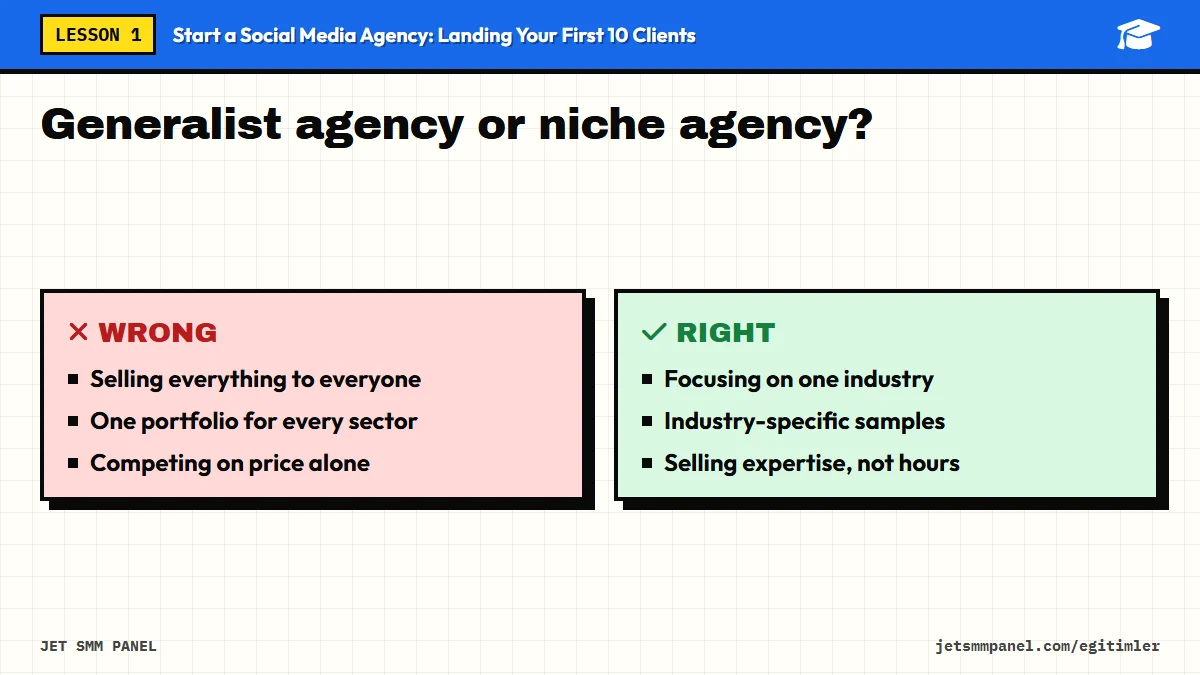
The most common beginner mistake is saying "I work with every industry." It sounds like more opportunity, but in practice it works the other way around. A cafe owner looking for help will trust someone who says "I manage social media for cafes and restaurants" more than someone who says "we do everything." The specialist speaks their language, understands their problems, and has samples that look like their own business.
Choosing a niche does not mean you must turn down work from other industries. Your niche is the focus of your marketing message and your portfolio. You can still take on a good fit from another sector; you just do not build your positioning around it.
A good niche sits where three questions overlap: Do you understand this industry? Do businesses here need social media and have budget for it? Can you reach them? Fill in the table below for each candidate niche. Score every criterion from 1 to 5. These scores are your own judgment, not market data.
| Criterion | Question to ask | Example scenario: Cafes and restaurants |
|---|---|---|
| Familiarity | Do you know the industry's language, seasons and customer types? | High score if you have worked in a cafe before |
| Visual potential | Can the product or service be shown visually? | Food and venue visuals are strong content material |
| Ability to pay | Can businesses set aside a regular budget for outside services? | More likely with established venues and small chains |
| Reachability | Can you easily reach the decision-maker? | Local businesses are open to in-person visits |
| Competition | Are there many agencies already specializing here? | Varies by city; research before scoring |
Pick the two niches with the highest totals and spend a week studying the social media accounts of businesses in those industries. Note which accounts post irregularly, which have outdated posts and which leave comments unanswered. These notes will be your most valuable material when you write cold outreach messages in lesson four.
You can define a niche by problem as well as by industry: "The first three months of social media for newly opened businesses" or "Content plans for appointment-based businesses." A problem-based niche can cover several industries while keeping your message sharp.
Once you have chosen a niche, write a one-sentence positioning statement. You will use it in your profile bio, your capabilities deck and your outreach messages. The formula is simple: who + what you do + toward which outcome.
"I manage social media for [industry] businesses through [service scope]; my goal is to build a consistent, measurable content routine around [the outcome the business wants]."
Example: "I manage Instagram for local cafes and restaurants with a monthly content plan, on-site shoots and community management; my goal is to keep the venue looking consistent and to answer booking questions quickly."
Never promise results in your positioning. Engagement, reach and sales depend on many factors you do not control, such as the algorithm, the industry, the season and the business's own product. What you can promise is the process: consistent content, on-time publishing and transparent reporting.
When you choose your model and niche, factor in your own capacity. Write down how many hours a week you can commit, which skills you are strong in (photography, video, copywriting, design, analytics) and where you will need help. For example, if video is not your strength, starting with a video-heavy industry could make your first months harder than necessary.
In the next lesson we will design service packages for this niche: what goes into a starter, standard and premium package, what stays out, and how to explain the difference to clients.
Choose three candidate niches and fill in the scoring table. In your top niche, review the social media accounts of 15 businesses and write a one-line observation for each. Then write your positioning statement and read it to a friend: can they understand what you do on the first try?