Blog Başlığı
Tarih
On TikTok, everyone eventually asks the same question: "Why didn't my video get on the For You page?" There's no single answer, but there is a logic. The For You feed is a recommendation system that shows people videos it predicts they'll enjoy, regardless of whom they follow. That means a small account can reach a large audience, and a large account's video can still go quiet.
In this lesson we'll separate two things: the signals TikTok itself has publicly described, and the "test pool" idea that creators talk about but that TikTok has never officially confirmed in detail. The goal is to build a production habit grounded in what's known, not in myths.
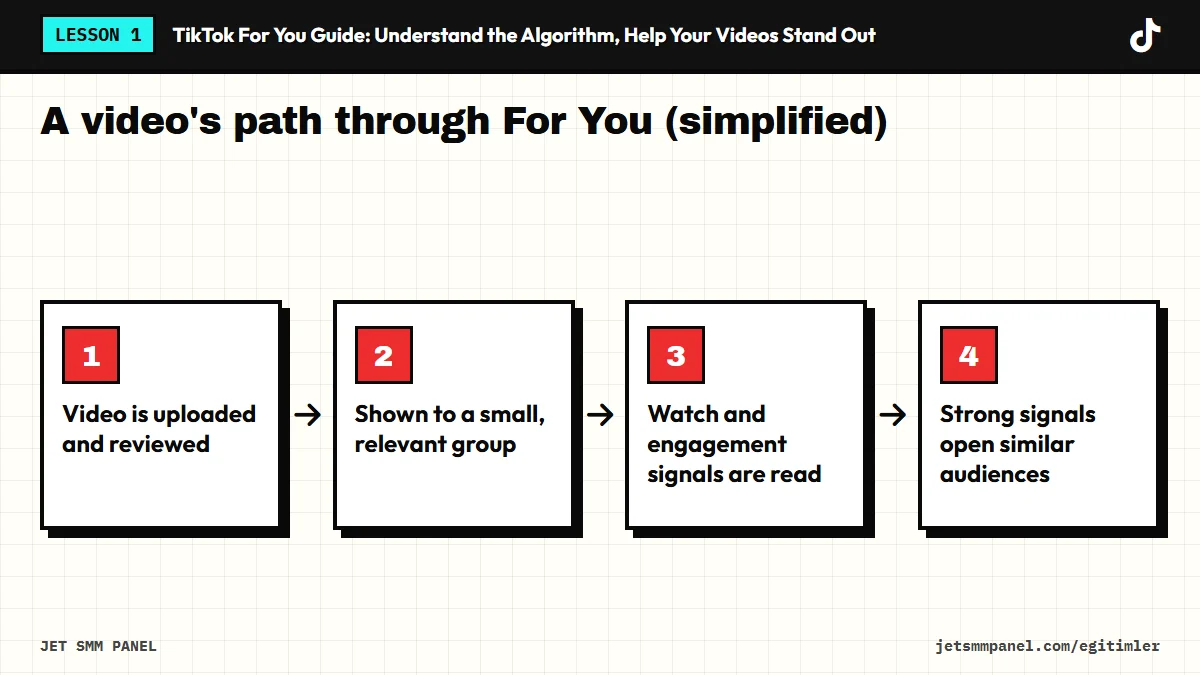
TikTok has explained its recommendation system in broad strokes on its newsroom and help pages. According to those explanations, recommendations come from a combination of several signal groups that carry different weights. The exact formula has never been shared; the table below simply summarizes the published categories.
| Signal group | What it includes | What it means for you |
|---|---|---|
| User interactions | Likes, shares, comments, accounts followed, videos watched to completion, content the user creates | Strongest area Every decision that improves watching and engagement pays off here |
| Video information | Content details like captions, sounds and hashtags | Supporting Helps the system understand who the video is for |
| Device and account settings | Language preference, country, device type | Low weight TikTok says these receive lower weight |
TikTok's own example is telling: whether a user finishes watching a longer video from beginning to end carries far more weight than a weak indicator such as the viewer and creator being in the same country. That one sentence explains why the rest of this course revolves around watch time.
TikTok has stated that neither follower count nor whether an account has had previous high-performing videos are direct factors in the recommendation system. There can be indirect effects (followers watching quickly, for example), but there is no official "big accounts get pushed automatically" rule.
A common creator explanation goes like this: a new video is first shown to a small audience, and if that group responds well, it opens to a larger audience, then a larger one still. TikTok does describe distributing new videos to users who are likely to be interested; however, the number of stages, the size of each stage and the thresholds between them have never been officially published.
Numbers like "the first 300 viewers", "you need a 70 percent completion rate" or "you need this many likes in the first hour" circulate widely online. They are community guesses, not thresholds confirmed by TikTok. This course won't give you fixed numbers like that; instead, you'll learn to compare against your own data.
Setting speculation aside, the practical reading is this: how a video's first viewers treat it tells the system whether it's worth showing to similar people. That's why it matters so much that early viewers don't swipe away, keep watching and leave some kind of reaction.
The recommendation system doesn't only read positive reactions. TikTok explains that users can long-press a video and choose "Not interested", and that this kind of feedback can lead to similar content being shown less. Quickly swiping away in the first moments is also, logically, a sign of low interest, even though no official formula has been published. That's why misleading covers and hooks may win a click in the short term but can work against the video when they don't deliver on the promise.
The system doesn't see your intentions; it sees viewer behavior. The checklist below is a set of questions to ask yourself before publishing any video:
Within its Community Guidelines, TikTok notes that some content may not be eligible for recommendation in the For You feed. That doesn't mean the video is removed, but its distribution stays limited. The list is updated over time, so check the current version in the Community Guidelines section inside the app.
If you're cross-posting a video you made for another platform, upload the original file from your phone rather than a watermarked download, and add the on-screen text again inside TikTok.
Instead of trying to "trick" the algorithm, focus on getting viewers to keep watching. These steps are also the backbone of the rest of this course:
Imagine a small coffee shop owner (a hypothetical example) who films 45-second "Welcome to our shop" tours and gets very few views. Using the same footage, they post a video that opens with "The 3-second way to froth milk at home" and reveals the result only at the very end. Because the topic is clear and the payoff is saved for last, viewers are more likely to watch to the end.
In the next lesson we'll zoom in on the most critical moment of this journey: the first 3 seconds, when viewers decide whether to swipe, and the hook types that are specific to TikTok.
Open your last 5 videos and answer the five checklist questions for each one. Write down the item that got the most "no" answers; that's the area you'll fix first in the coming lessons.