Blog Başlığı
Tarih
A staggering amount of content is published every day, and only a tiny fraction of it makes people think "I have to send this to someone." That gap often looks like luck. Partly, it is: timing, what's trending that day and who happens to see the post first are all factors you can't control. But it isn't all luck. Behind widely shared content there are recurring psychological reasons and recurring structures.
Throughout this course we'll take those structures apart and rebuild them piece by piece: hook, story, retention, close and testing. The first lesson covers the foundation of everything: why do people save a piece of content, share it, or comment on it? Without a clear answer to that question, even the best hook falls flat.
Going viral means your content spreads far beyond your followers because people carry it forward. No formula can guarantee that spread. Two videos from the same account, made with the same care: one stays quiet, the other takes off unexpectedly. The formula you'll learn here exists to raise the odds for every piece of content and to make whatever works repeatable.
Be skeptical of any advice that says "use this hook and it will blow up, guaranteed." Virality can't be predicted in advance. What you can do is increase the number and quality of your experiments and read the results carefully. This course gives you the system for that, not the outcome itself.
Accepting this is actually freeing. Instead of loading a single post with the pressure of "this has to go viral," you treat every post as an experiment. If the experiment flops, you gain data. If it works, you turn the format into a series. That's exactly what we'll do in the final lesson.
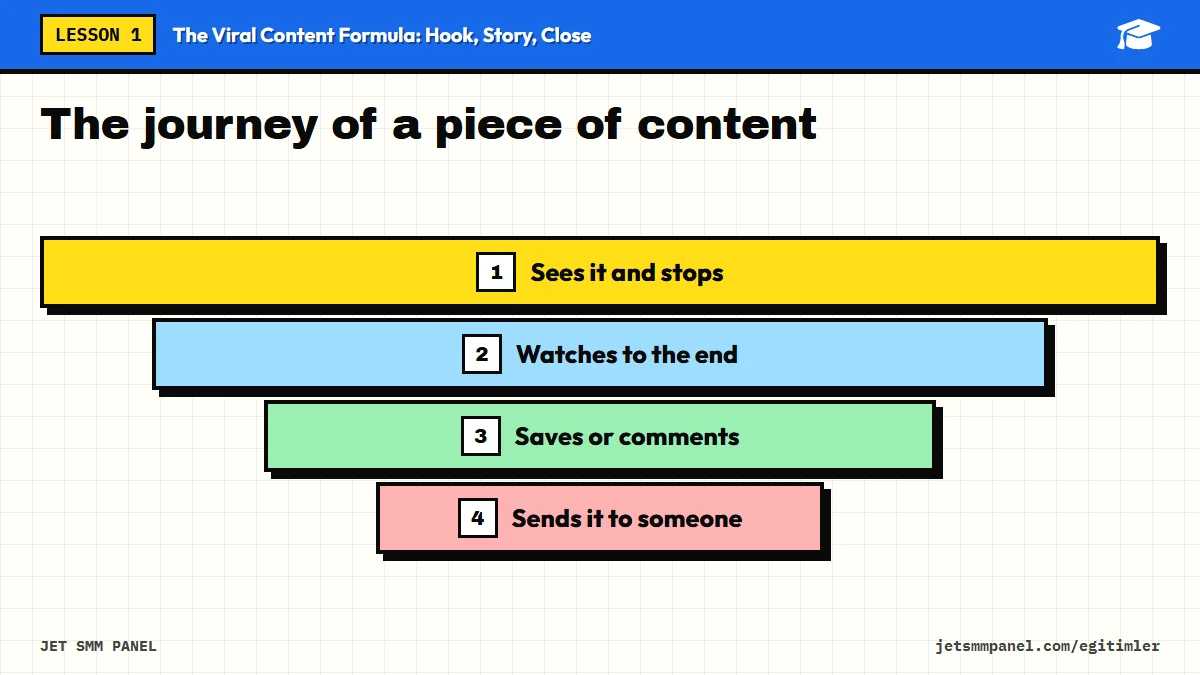
When viewers come across your content, they make a quick series of small decisions. First, they stop or keep scrolling. If they stop, they keep watching or drop off after a few seconds. If they stay until the end, they either do something or they don't: save, share, comment, visit your profile. You lose part of your audience at every stage. Each part of the formula maps to one of those stages:
In this lesson we focus on that last stage, because if you choose the wrong engine, it doesn't matter how well you build the first two stages: viewers will finish the content and move on without doing anything.
We can group the reasons people pass content along into four main buckets. These aren't rigid scientific categories; they're a practical framework that makes content planning easier. In real life, most strong content runs two engines at once.
Strong emotion moves people to act. Some studies in marketing and psychology suggest that high-energy emotions such as awe, excitement, amusement or anger drive more sharing than calmer ones like sadness or contentment. In practice, that means a gentle smile may not be enough; you need a laugh, a surprise or a genuine "wow."
Utility is the main engine behind saving. A recipe, a checklist, a shortcut, a price comparison... The viewer thinks "I can't use this right now, but I don't want to lose it." Utility also drives sharing: the feeling of "my sister needs to know this" comes from a desire to help.
People express themselves through what they share. An inside joke from a profession, a detail only locals of a city would understand, a value worth standing up for... This kind of content makes people say "that's exactly what I've been trying to say." Identity content is especially strong for shares and tags: a friend tagged under a post with "this is literally you" is identity at work.
Curiosity comes from the gap between what you know and what you want to know. According to what psychology often calls the "information gap" idea, people are willing to spend time closing that gap. Curiosity mostly feeds watch time and rewatches; on its own it's a less common reason to share. But it's the vehicle that carries the other engines all the way to the end.
| Engine | The viewer's inner voice | Behavior it feeds most | Example scenario |
|---|---|---|---|
| Emotion | "I can't believe this, you have to see it" | Shares, comments | A barber welcoming back their very first customer years later |
| Utility | "I don't want to lose this" | Saves | A coffee shop's ratio chart for cold brew at home |
| Identity | "This is so me / so us" | Shares, tags | A boutique owner's sketch about the "just browsing" customer |
| Curiosity | "How does it end?" | Watch time, rewatches | "What I turned this old dresser into in three days" |
Let one engine lead in every piece of content. Content that tries to force all four usually does none of them well. Curiosity, on the other hand, is a carrier you can add to almost any format: even a utility post can get a curiosity layer like "the third step is the one most people skip."
Mixing up these three behaviors is one of the most common reasons people create the wrong content. Saving is private: viewers do it for themselves and nobody sees it. That's why utility dominates here. Sharing is social: when viewers send content to someone, they also say something about themselves. What they send reflects on their image, which is why identity and emotion are stronger here. Commenting is participation: the viewer wants to show they have an opinion, know something, or disagree.
So when you plan content, don't ask yourself "how does this go viral?" Ask "what action do I want from the viewer, and what engine drives it?" That question also determines which hook, which skeleton and which close you'll choose.
Outrage and polarization can bring a lot of engagement in the short term. But content that misleads viewers or pits people against each other erodes your account's credibility and can also run into community guidelines. Use the emotion engine to tell a real story powerfully, not to manufacture fake controversy.
Ask these questions before you film an idea. If "no" answers dominate, don't throw the idea away right away; try strengthening its engine first.
That last question matters. Off-topic content may spread and still fail to bring you the right audience. A random cat video that blows up on a coffee shop's account may not win followers who actually love coffee. The goal isn't just views; it's views from the right people.
Example scenario: A hair salon plans a post called "4 questions to ask before you dye your hair." The leading engine is utility (saves), the second is identity (people who think "this happened to me last month" will comment). Inner voice: "I'll open this next time and read it." The topic fits the account's audience perfectly. From the formula's point of view, this is a solid starting point.
Open your last 10 posts. For each one, write down the leading engine (emotion, utility, identity, curiosity) and the action you wanted from viewers (save, share, comment) in a table. Then look at your most saved and most shared posts: which engine stands out? This table will be your starting point for the rest of the course. In the next lesson we move to the first and most critical step in running these engines: hook lines that stop viewers in the first seconds, plus templates you can use right away.