Blog Başlığı
Tarih
In the first lesson you saw the viewer's journey: stopping, watching, engaging, carrying. The first gate on that journey is the hook. The hook is the opening that makes viewers stop scrolling and think "wait, what's this?" In a video, the first line and first frame form the hook; in a carousel, it's the first slide; in a text post, the first line; in a long video, the title and thumbnail work together as the hook.
A hook alone doesn't make content succeed, but a weak hook can make great content go unwatched. In this lesson we'll break the hook into layers, get to know its types and build 12 ready-made templates so you never stare at a blank page.
A hook isn't just the first sentence you say. Viewers take in the opening through three channels at once, and the hook gets stronger when those channels support each other.
These layers are platform-independent. In a carousel, the visual and text are the first slide. In a long video, the thumbnail is the visual layer, the title is the text layer and the first seconds are the spoken layer. The logic is always the same: at first contact, viewers should understand what they're getting and feel curious.
The table below shows the most common hook types, each with a fill-in-the-blank template. Fill the bracketed parts with your own topic. The examples are hypothetical scenarios.
| Type | Template | Example (hypothetical) | Leading engine |
|---|---|---|---|
| 1. Mistake warning | "If you're a [audience] and you [common mistake], stop." | "If you brew coffee with boiling water, stop." | Utility |
| 2. Belief challenge | "Everyone says [common belief]. I think it's the opposite." | "Everyone says short hair is low-maintenance. I think it's the opposite." | Curiosity |
| 3. Result first | "This [result] was made with [unexpected source]." | "This shop window was built from old crates only." | Curiosity |
| 4. Identity call-out | "Every [specific group] knows this one." | "Every boutique owner knows this customer." | Identity |
| 5. Numbered list | "[Number] things for [topic], and number [x] is the one most people miss." | "4 questions before you dye your hair, and the last one matters most." | Utility |
| 6. Mid-story | "[Tense moment], and that's when I realized [thing]." | "An hour before opening, the machine broke, and that's when I realized..." | Emotion |
| 7. Targeted question | "Do you also [specific situation]?" | "Do you also change your outfit three times every morning?" | Identity |
| 8. Before and after | "[Time] ago it looked like this. Now look." | "Three days ago it looked like this. Now look." | Curiosity |
| 9. Behind the scenes | "As a [profession], there's something we don't tell you." | "As a hairdresser, there's something we don't tell you." | Curiosity |
| 10. Effort shortcut | "Instead of [long process], do [shortcut]." | "Instead of an hour of ironing, try this folding method." | Utility |
| 11. Challenge | "Very few people can do this [condition]." | "Very few people can pour this latte art on the first try." | Identity |
| 12. Comparison | "[A] or [B]? I'll show you the difference with [proof]." | "Expensive brush or cheap brush? I'll show you the difference on a single lash." | Curiosity |
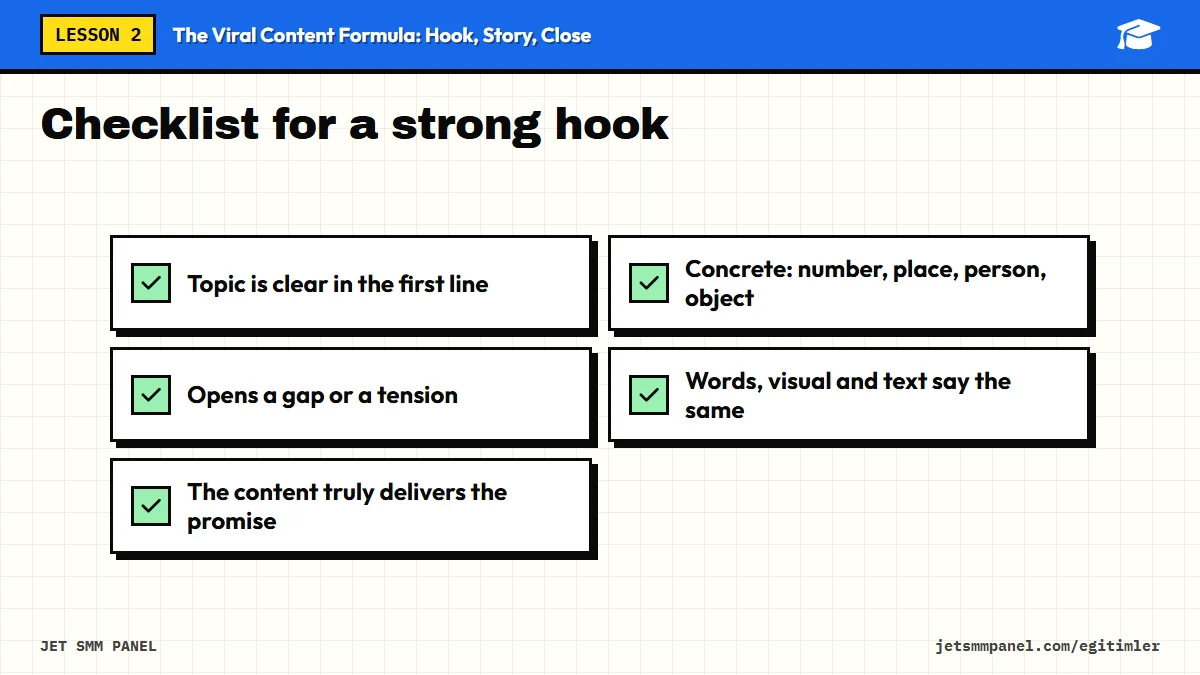
Notice what every template has in common: it says something concrete. "Boiling water" instead of "coffee tips," "4 questions" instead of "things to watch out for." Concreteness gives the viewer's brain enough information to answer "is this about me?"
[Who] + [a concrete situation or claim] + [an open gap]. Example: "If you make coffee at home (who) and pour the water right after it boils (concrete situation), that might be why your cup tastes bitter (gap: so what should you do?)."
A long warm-up, a greeting or "today I'm going to tell you something" kills the hook. Viewers should know what this is about from the first sentence. You can add context later.
A hook asks the question; it doesn't give the answer. "Don't brew coffee with boiling water" leaves a gap: why, and how hot should it be? If the hook says everything upfront, the viewer has no reason to stay.
A hook is a contract. If you say "the last one matters most," the last item really has to be strong. A hook that breaks its promise works once, and then viewers start distrusting your account.
Don't invent false information, fake numbers or events that never happened to make a hook stronger. It might raise your stop rate in the short term, but it comes out in the comments and damages trust and your account's reputation. Always keep the line between exaggeration and lying well on the safe side.
Great hooks rarely arrive on the first try. Many professional creators write several hooks for a single piece of content and pick the best one. Turn it into a habit with these steps:
Keep a running hook list in a notes file. Every time a piece of content makes you stop, write down its first line and note its type. Within a few weeks you'll have a hook library tailored to your niche and ready to test. Don't copy other people's sentences; borrow the structure and fill in your own content.
Pick a content idea you plan to publish next week and use this lesson's drill to write at least 10 hooks for it. Choose your top three and, for each, note what the first frame will show and what text will appear on screen. The hook stopped the viewer; now what? In the next lesson you'll learn the story skeletons that carry viewers from start to finish: problem-solution, before-after, list, plot twist and more.
Buy the course to unlock the remaining 4 lessons.