Blog Başlığı
Tarih
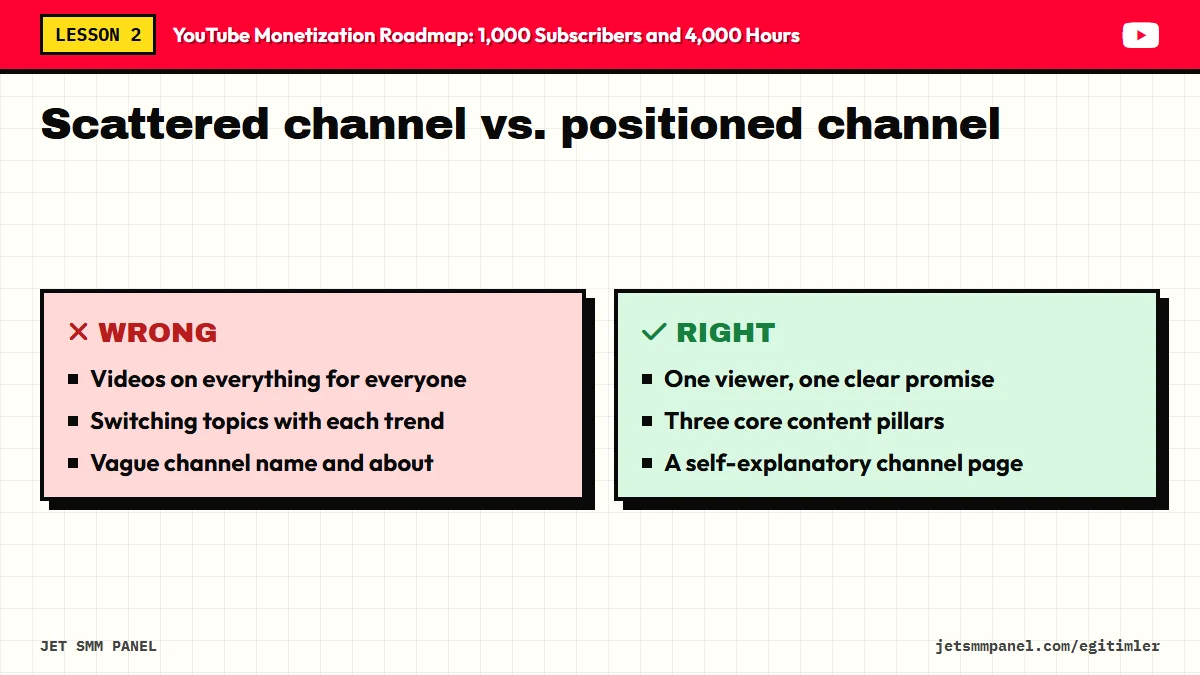
Most new channels make the same mistake: a recipe one week, a gaming video the next, then a vlog. Because every video speaks to a different audience, no viewer ever thinks "I should follow this channel". YouTube's recommendation system also struggles to understand who your videos should be shown to.
Positioning means your channel can be described in a single sentence: who is it for, what is it about and why should people watch you? In this lesson you will learn how to choose a sustainable niche, write your channel promise and set up your channel page around that promise.
A clear niche makes it easier to reach the thresholds from the previous lesson in several ways:
Your niche also affects your earnings. One of the factors behind ad revenue is how interested advertisers are in that topic and that audience. Topics such as finance, technology, education and business are generally known for strong advertiser interest, but competition there is also high. Choosing a niche you do not care about just because it "pays well" is rarely sustainable.
A good niche sits where three questions overlap: Do you enjoy and know this topic? Are people searching for and watching it? Can you keep making videos about it for at least a year? Fill in the table below for each niche idea you have and score each question from 1 to 5.
| Criterion | Ask yourself | Weight |
|---|---|---|
| Interest | Would I get bored after 100 videos on this? | Critical |
| Knowledge and experience | Can I genuinely teach or show viewers something new? | Critical |
| Demand | Does YouTube search suggest related queries, and are similar channels being watched? | Critical |
| Idea depth | Can I list 30 to 50 video ideas right now? | Important |
| Income potential | Are there products, services or brand partnerships that fit this audience? | Important |
| Production load | Can I produce consistently with my current gear and time? | Important |
The idea with the highest total is usually the most sensible place to start. An idea that scores low on "demand" will grow slowly no matter how much you love it, and an idea that scores low on "interest" tends to get abandoned within a few months.
"Cooking" is a very broad niche; "weeknight dinners for students on a tight budget" is narrow and clear. Starting narrow usually works better, because being the first choice of a small but well-defined audience is easier than being one of hundreds of options for a huge one. As your channel grows, you can widen the niche step by step.
A good way to expand is to follow your current viewers' next need. Someone watching budget student dinners may later be interested in weekly meal planning, grocery shopping or quick desserts. Moving into these neighboring topics lets you grow without losing your audience. Jumping to a completely unrelated topic, on the other hand, can mean your existing viewers skip that video and the recommendation system gets confused.
Your channel promise is the one sentence that explains why a viewer will come back. It is a compass for you (does this video fit the promise?) and the first line of your channel description.
I make videos about [topic] for [who]; every [frequency] a new video helps you [result the viewer gets].
Example scenario: "I make gear and recipe videos for people just starting to brew coffee at home; every Tuesday a new video helps you make cafe-quality coffee without buying an expensive machine." This sentence clearly states the audience (beginners), the topic (home coffee), the frequency (every Tuesday) and the result (cafe quality without an expensive machine).
To avoid getting stuck on one narrow topic and repeating yourself, split your niche into 3 content pillars. Every video should belong to one of them. Sticking with the coffee example:
Rotate your upload schedule through the pillars: tutorial, comparison, personality, then tutorial again. You get both search traffic and loyal viewers, and coming up with ideas becomes much easier.
When a viewer likes one of your videos, they often check your channel page and decide within seconds whether to subscribe. That page should communicate your promise at first glance.
If your channel is already full of videos on different topics, you do not have to delete them all. Feature the videos that fit your new niche and remove the old ones from your home page sections. You may consider making private any videos with copyright issues or that you feel lower the quality of your channel, but remember that watch time on private videos does not count toward the Partner Program.
No. Formats that do not show your face, such as screen recordings, hands-only footage or narrated presentations, can also succeed. What matters is that each video contains an original contribution of your own: your narration, your experience, your analysis. Channels that stitch together other people's content or mass-produce videos from a single template may run into trouble in the monetization review under the policies in place at the time of writing.
Now that your channel is positioned, the next question is: which videos should you make in this niche? In the next lesson you will see how to find video ideas your viewers are actually looking for and how to do keyword research.
Score up to three niche ideas using the table and pick the one with the highest total. Use the template to write your channel promise, define your three content pillars and list at least five video ideas for each pillar. Finally, update your channel page using the checklist.
Buy the course to unlock the remaining 6 lessons.